Pages

Showing posts with label Osaka. Show all posts

Monday, May 19, 2014

OSAKA: GREAT TIPS & TRICKS


This is the unedited version of my sidebar article for the June 2014 issue of Cruising, a Manila Bulletin publication. Thanks again to the editors.


1. Do not miss the foreign exchange counter at Kansai International Airport. You will not miss it due to the queue: 

Step 1: Someone gives you a form. Step 2: Someone checks your form. Step 3: Someone takes your form and money. 
Step 4: Someone releases your crisp Yen bills.

It will be difficult to withdraw from Japanese ATMs and finding a ForEx shop may be difficult.


2. Osaka has two main railway operators at the airport, Japan Railways (JR) and Nankai Namba. It is easy to be intimidated by the ticket vending machines, so approach any staff at the counter beside them for any help, to save time.


3. Breakfast at most high-end hotels can be expensive. Look for the closest Yoshinoya, for a hearty bowl of beef strips (small bowls at ¥280/P120). The rules are simple: sit, eat, go. There will be someone waiting for your seat more often than not. 


4. Soda is expensive. but service water is clean. A small bottle of cola at restaurants is around ¥200/P85.


5. When having Furai (deep fried meat or veggies, different from tempura), you should only dip your stick once into the bowl of sauce, as respect for other diners. The Ebi Furai (deep fried prawn) is a must-try.


6. When paying at a restaurant (or any other establishment), place your money on the small tray beside the cash register. You should also get your change from here. It is bad etiquette to hand your money directly to the cashier.


7. One subway station may have multiple lines passing through them. The easiest way to remember which line you need to take is by remembering their colors. Train tickets start at ¥200/P85. A station may be humongous so remember what your exit number is. Getting out of the wrong one may mean another 15-minute walk back to where you should have been.
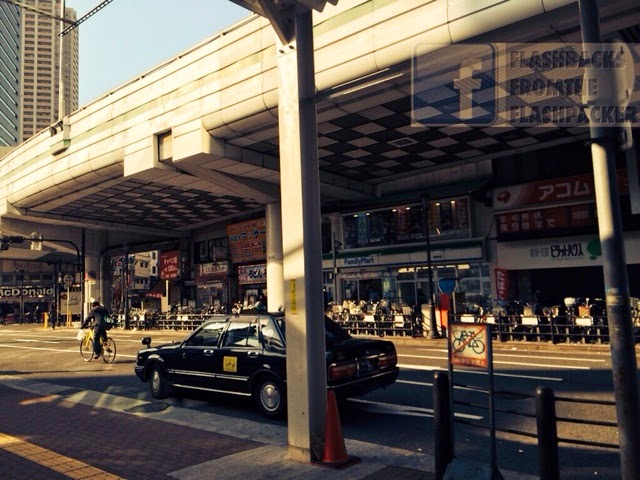


8. Taxi is expensive and may only be practical for short distances when there are three to four passengers. A five to ten minute ride may set you back ¥650/P280, so be wise. If it's one to two train stations away, it may be cheaper to take a taxi. Or better, just walk.


9. Trinkets as pasalubong can also be expensive. Decent keychains are around ¥400/P170 and fridge magnets are at ¥500/P210. You can just get authentic gifts for friends from convenience stores like 7-11 or Family Mart.


10. Those working in the service industry do not expect you to tip. If you really want to appreciate great customer service, you may just give them small peso bills and say they are souvenirs from your country. •

Saturday, May 17, 2014

My Osaka Opening


Everyone wants to go to Tokyo. Well, at least those I know. But Tokyo was too crowded for me. Too busy. And yeah, too expensive.

So when a budget airline started flying to Osaka, I got very excited. Four years and several seat sales later, I finally booked a real promo ticket. 

Elmer and I landed in the evening at Kansai International Airport. The customs staff stopped us (tough luck, yup, both of us). Now a tip for all those who'd be as unfortunate as we are - if you are never hiding anything prohibited, there is no reason to panic. Try searching Australia's Border Patrol on YouTube. 

The lady asked that we lay our luggage on their counter. She scanned all the contents of my for-a-fee baggage, and said "Thank you. You can go."

Right before we exited the airport, we were stopped by civilian airport police who asked us to show our passports. I was doubtful. What if this was a setup. A scam. Worthy of an episode on Scam City.

"Where are you going?", he asked. He looked harmless but the clandestine act of flashing his badge was a red flag for me.

"Osaka," I said. 

Come on, I was tired and hungry and I wasn't even carrying any drugs. Why the hell would we be stopped, twice, when everyone else seemed to be just breezing through all of the  checkpoints.

"Where are you going to stay?," the guy asked. At this point, I can tell Elmer was really worried. The police already had asked for our passport. Which I didn't want to give him. But i didn't want to spend my night in the airport detention room either. 

Light bulb moment: I took our hotel voucher out of my coat's inner pocket and instead of trying to give him a I-booked-a-hotel defense, I asked, "How do we get to Namba?".


His face transitioned from strict-looking to excited. Like a new tour guide who just got his first client. He pointed us to the train station.

"Just take the elevators up to the second floor, then turn left."

I smiled while he returned our passports. I thanked him and his "Goodbye!" was this country's way of saying "Welcome to Japan!"


Osaka is actually an hour away from KIX. You can take the train. Or the bus. Or a taxi. Taxi is a lot more comfortable and should be fine if you are willing to pay P16,000. One-way. No typo, no extra zero: sixteen thousand pesos.

So, after changing money at the airport, we took the train. The station was right outside the airport's main building. And when we got there, I was totally confused. 

So there's JR. And there's Nanka. 

If there was one thing I hated about my pre-research, it was that I couldn't figure out how the railway systems in Japan work. I mean, Seoul's Subway System looked more complicated than a spider's web but it doesn't take a genius to figure it out.  But Osaka's? You have to experience it to understand it. 

I was standing in front of the ticket machine. Above me is a complicated  train system map. And around me are possibly more than twenty other machines. I looked at the monitor and after five minutes, I concluded that I couldn't figure it all out.

Elmer asked the counter and the staff explained we can buy the ticket from him. Why didn't the machine say so? The ticket to Namba Station, our base for the trip, was 1100 Yen. Around P500. That wasn't bad at all. Considering that we were all alone, save for one guy, in car number 6.

A little over half an hour later, past the suburbs, we got to Osaka's Namba Station in the Minami Area.

It was a good thing our hotel was right at the station. We could even call someone to pick us up from their special kiosk at the station. But we were in a hurry to check in. 


Now, the hotels in Japan do not come cheap. I mean, you can get hotels for as little as P2,000++ but that'd mean living in a matchbox. And with the amount we paid (about P7,500 per night), we got a bigger room. A great view of Osaka. A couch. A bath tub. And a bed that can sleep twenty people. Okay, I was exaggerating, but it was really big. 

The only problem I have with paying close to $200/night is that the rate does not even include breakfast. No, not even one piece of a teeny weeny Takoyaki Ball. •